
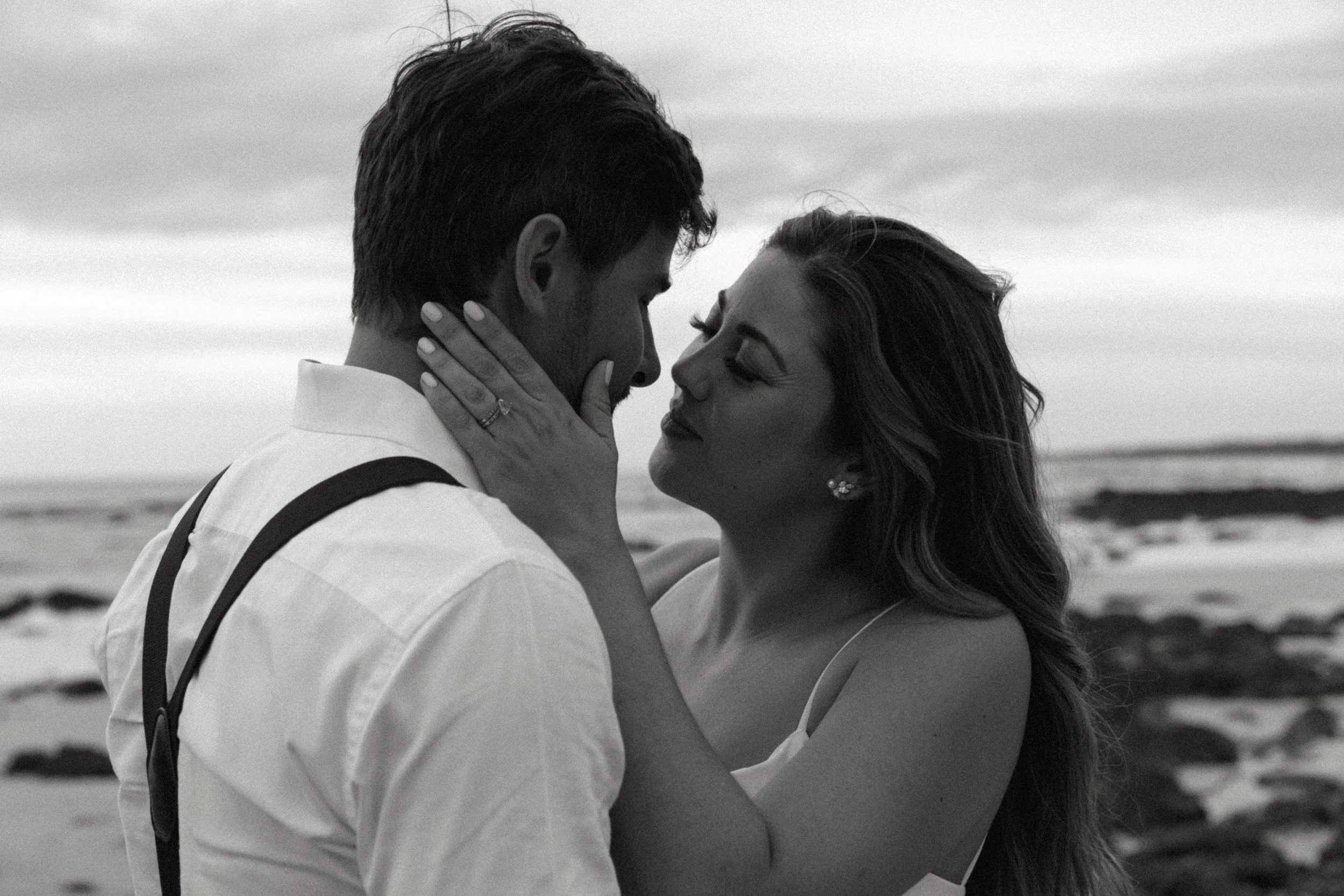
Most couples begin their photography search by responding to how images look. Something catches their eye — the light, the composition, the mood — and they start saving galleries without necessarily having language for why they’re drawn to them.
Two terms tend to surface early in that process: editorial and documentary wedding photography. They’re often presented as opposites, or worse, as fixed styles you must choose between. In reality, the distinction is more nuanced — and understanding it can help you make a decision that feels grounded rather than reactive.
This article is about clarifying what editorial and documentary wedding photography actually involve, how they shape the experience of the day, and how to decide which approach aligns with how you want to feel — not just on the wedding day, but years later when you return to the photographs.
Editorial and documentary are approaches, not aesthetic labels
One of the most common misunderstandings is that editorial and documentary describe how photographs look. In practice, they describe how photographs are made.
Two photographers can deliver visually similar images while working in completely different ways. Conversely, two photographers can share an approach and produce very different aesthetics depending on light, location, and subject.
The real difference between editorial and documentary photography lies in control, authorship, and intent.
What editorial wedding photography actually means

Editorial wedding photography borrows its structure from fashion and magazine work. The photographer takes a more active role in shaping the image, often guiding posture, movement, and placement within a frame.
This approach prioritises:
Strong composition
Intentional posing or direction
Clean, controlled environments
Visual impact in individual frames
Editorial photography often produces images that feel striking on their own — the kind you might expect to see in print or on a cover.
How editorial photography shapes the wedding day
Because editorial photography relies on control, it usually requires:
Allocated time for portraits
Willingness to pause or repeat moments
Comfort with direction
This doesn’t mean the day becomes artificial, but it does mean that photography is a visible part of the process. The camera is acknowledged, and at times, prioritised.
For some couples, this feels reassuring. For others, it feels interruptive. Neither response is wrong — but the distinction matters.
What documentary wedding photography actually means

Documentary wedding photography is rooted in observation rather than orchestration. The photographer responds to what unfolds rather than directing it.
This approach prioritises:
Behaviour over posing
Sequence over individual highlights
Emotional continuity
Minimal interruption
Documentary photography focuses less on how things should look and more on how they actually happen.
How documentary photography shapes the wedding day
Documentary coverage tends to blend into the background.
The day moves forward without pauses for the sake of images. Moments are allowed to complete themselves. The camera adapts to the environment rather than reshaping it.
This often results in:
A calmer experience for the couple
Fewer transitions between “being photographed” and “not”
Images that feel connected to one another rather than isolated
For couples who value presence and flow, this can feel deeply supportive.
Neither approach is more “authentic” by default
There’s a common assumption that documentary photography is inherently more authentic. That’s not always true.
Authenticity comes from alignment — between the couple, the photographer, and the environment. An editorial approach can still reflect genuine emotion. A documentary approach can still feel contrived if expectations are misaligned.
What matters is whether the approach supports how you naturally behave under attention.
The key difference is authorship
At its core, the difference between editorial and documentary photography is about who authors the moment.
In editorial photography, the photographer authors the frame.
In documentary photography, the moment authors itself, and the photographer responds.
Most photographers sit somewhere along this spectrum rather than at either extreme. Understanding where someone tends to land can tell you far more than any label.
How these approaches affect how photos age

Time is often the clearest lens.
Editorial images can feel powerful immediately. They’re designed to impress, to hold attention, to stand alone. Over time, some couples find they return to these images selectively rather than repeatedly.
Documentary images often grow in significance. They may feel quieter at first, but they align more closely with how memory actually works — layered, contextual, emotional.
Neither ages “better” universally. They age differently.
How location influences which approach works best
Environment matters.
In New England, for example:
A Newport estate wedding may lend itself well to editorial structure
A Cape Cod wedding may benefit from documentary fluidity
A New York wedding may require a hybrid approach due to pace and density
Some locations assert themselves strongly. Others recede. The photography approach that works best often responds to that dynamic rather than resisting it.
What couples often misunderstand when choosing between the two

Several assumptions come up repeatedly:
That editorial means no candid moments
That documentary means no portraits
That you must choose one or the other
In reality, most thoughtful photographers integrate elements of both. The difference is in emphasis, not exclusion.
The question isn’t can this photographer do both?
It’s which do they prioritise when trade-offs arise?
Questions to ask yourself before choosing
Rather than asking which approach is “better,” consider these questions:
Do I feel more comfortable being guided or being observed?
Do I want the camera to slow the day down or move with it?
When I imagine looking back, do I value impact or continuity more?
Do I enjoy being photographed, or do I tolerate it?
Your answers will usually point you toward the right balance.
How to evaluate a photographer’s true approach
Words can be misleading. Galleries are more revealing.
When reviewing work, look for:
How moments connect across a full wedding
Whether people appear self-aware or absorbed
How often scenes feel paused versus unfolding
Ask photographers how they make decisions when time is limited or conditions are imperfect. Their answers often reveal more than their portfolio.
Why hybrids work best when they’re intentional
Many photographers describe themselves as offering a blend of editorial and documentary photography. This can be meaningful — or meaningless — depending on how intentional the balance is.
A thoughtful hybrid approach understands:
When direction supports comfort
When restraint preserves meaning
When a moment benefits from shaping, and when it doesn’t
Hybrids work best when they’re principled, not ambiguous.
Frequently Asked Questions
Can we have both editorial and documentary photos?
Yes. Most photographers work along a spectrum. The key is understanding where their emphasis lies.
Is editorial photography more suited to luxury weddings?
Not inherently. Luxury is about intention and experience, not just visual polish.
Does documentary photography mean fewer portraits?
Not necessarily. It usually means portraits are approached with less posing and more interaction.
Which approach is better for camera-shy couples?
Many camera-shy couples feel more comfortable with a documentary-led approach, but this depends on personality.
How do we know which approach we’ll prefer long-term?
Consider which images you return to when you look at other people’s weddings — the standout frames or the quieter moments.
A final thought
Choosing between editorial and documentary wedding photography isn’t about picking a trend or a label. It’s about choosing how involved you want the camera to be in your experience — and how you want your memories to be shaped.
When couples understand the difference, the decision often becomes less about comparison and more about alignment. And alignment, more than anything else, is what leads to photographs that continue to feel right.
If you’d like to explore this further, you can check out my own personal approach by heading to my portfolio, or you can reach out to me if you’re ready to start planning your day.